Rolling Short Puts
In this post I will share what it means to roll a short put. First of all, for those who don’t know, a short put is a position taken where the buyer (someone else in the market) gives the seller (in this case me) money to enter a contract. In this contract, I am agreeing to hold that money in exchange for a contractual obligation that if the price of the stock or ETF is below that price on the target date, I will buy the position for the agreed upon price. In this contract, that price is called the “Strike” price.
So where’s the advantage for each party? First let’s talk about the buyer. The person paying for this contract is buying it because they either want protection for a position they already own, or they are just paying to buy the contract because they believe it could drop by a lot, and therefore gain exponentially compared to their purchase price if it does.
In my position, the advantage is a bit more boring. Someone is paying me real money because they believe the price will be BELOW the target price when the expiry date comes. If the price is even .01 above the Strike price, then I just keep that persons money, and the contract expires worthless. There’s no exponential gain in it for me, it’s just being patient, letting time pass, and letting theta Θ burn off a little each day.
Most of the time though, when a contract is close to expiration, I prefer to pay even a tiny amount to close the contract, and then look for a new one. This process is called ROLLING.
There are advantages to rolling rather than just let contracts die. I used to enjoy watching contracts die to 0.00 because it was satisfying to be 100% right, and keep every penny. Sometimes I still do it, because that little hit of dopamine can still bring a smile to my face. Most of the time though, I am using my calculator brain to tell me to just get rid of that contract with it’s very profitable, and setup a new one. Or, in some cases, I will close a contract and just wait because I don’t think there is a good opportunity in the moment.
Let’s talk about rolling though, that’s the whole point of this post. I am going to use a case where I was losing hard on a contract I made, but I just kept rolling it forward and forward until it finally became profitable. The image I have here is the most recent roll, when it flipped from what I call a “RedRoll” to a “Green Roll“.
This screen shot is from a special software I wrote on my own to help me visualize positions rather than just looking at numbers. For me it’s like a map, it’s like a gameboard, it’s like a battlefield. It’s so many things that I could go on for chapters explaining everything this software can do.
At the end of the day, it’s the core behind my whole concept of the Slinky that gave birth to this software 6 years ago. (no, I am not trying to sell the software)
You’re probably going to have to zoom and pan on the image if you’re reading on a mobile device, but it’s worth it to understand the details I will explain below.
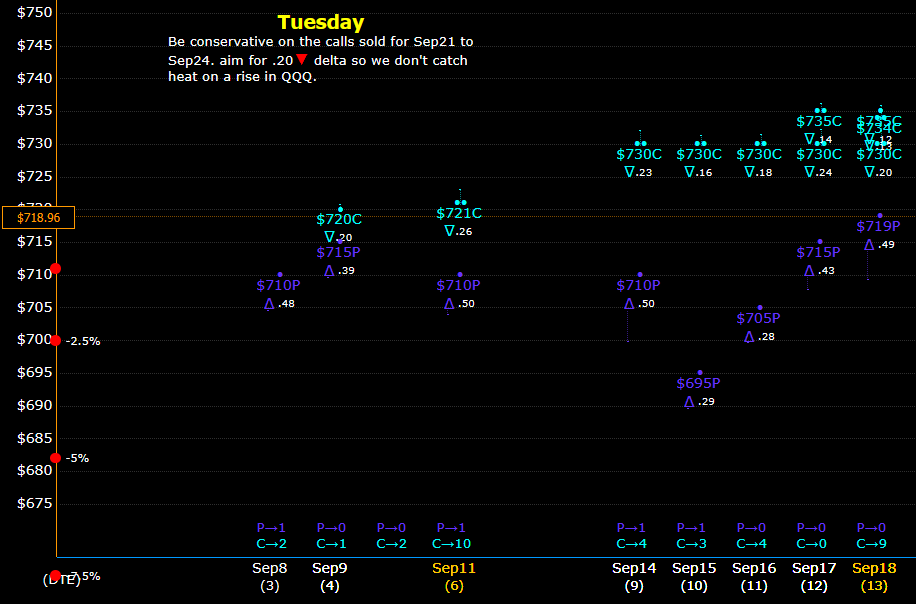
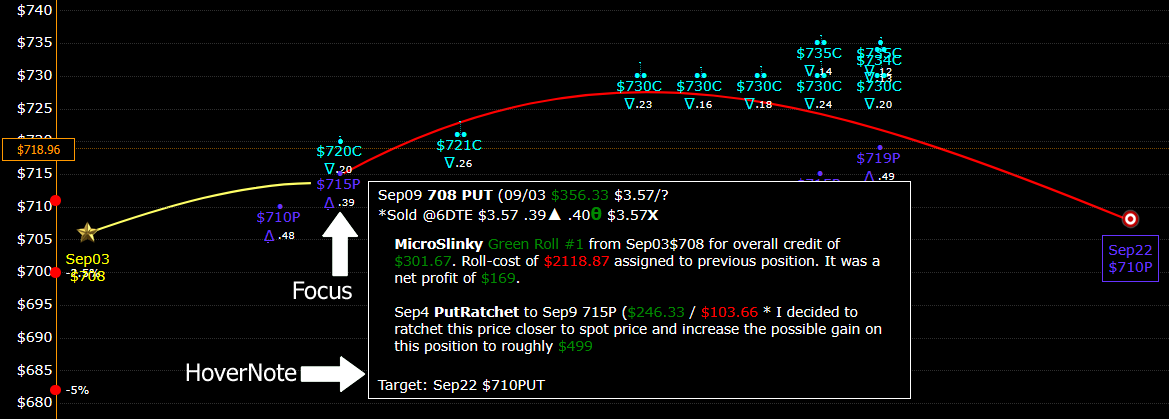
The first place to start on this map is with the price of the stock. This is the QQQ (basically like the NASDAQ100). It’s a fairly expensive ETF, but I have zero intention of actually buying it. I only do the contracts. That little orange box on the left with a horizontal line that crosses the page is the spot price right at this moment. QQQ last sold for $718.96 so that price divides the image.
The focus right now is on that contract for Sep9th for $715. It’s colored purple and a P is after the price. Being quirky the way I am, I use purple because both Put and Purple start with a P. When I sold this short put, I originally sold it for a strike target of $708, but that was when QQQ was at a considerably lower price. On Sep4th I adjusted my strike, and received a bit more cash to tighten my risk a little.
There’s this thing I build into my SlinkyMap that for me is essential in knowing what a position is made of, where it came from, and even where I think it’s going. I am talking about the HoverNote. This note appears when I pass my mouse over the position. It’s programmed to bring up any notes I have entered on that position.
The yellow line and the star mark where this position came from. Previous to this, it was a $708P short put contract. So the trail shows how it’s connected to the past. This detail isn’t so critical, but part of knowing how things have been going as the slinky keeps flipping and rolling forward through time. The most important detail from this roll comes from what it’s finally become. Earlier I mentioned “RedRolls” and “GreenRolls“. This is the fundamental power of the slinky, and why I almost never lose. Every time I close a contract, and open a new one, it’s a roll. That contract sequence is like a train, and what a lot of traders do which in my opinion is a failure, is they just close a contract and move on. They even will talk about how history has nothing to do with the future, and to just close a contract and get over it, and look for your next opportunity.
I never liked that because in doing that, you also can forget your losses, and think you’re winning on your next trade without ever taking into account that you had lost a sequence of trades previously, and have just moved on like they mean nothing. I call this the ShadowLedger. In tax accounting, and the performance metrics shown to you by your brokerage it’s complete BS, but for the purposes of the strategy, it’s essential. What it does is ensure that I cannot declare a “win” or a “GreenRoll” until I have completely overcome absolutely every loss in the sequence of connected trades up to and including the present one.
If you zoom in on the HoverNote, you will see how it says that the Roll-cost of $2,118.87 was assigned to the previous position. That was a sequence of 5 trades where the contract kept being pressured because it was ITM (in the money) but rather than panic, I just kept moving it little by little, even paying sometimes to lower the strike, but always with the intention that the market was going to pay it’s way out of that mess, not me.
Should I have just taken the loss, and moved on? In reality that’s what I did. Each time I closed the losing contract, and opened a new one, I was accepting the loss, but creating a new contract that would pay for it eventually. On that particular sequence, I brought in what I call the SWAT Team, which is a strategy that would require a post of it’s own to explain. I can do that later.
The key now is, this contract is a GreenRoll, and it’s #1 because this is the first time it’s closed a contract green, and started a new one. Is it a huge amount? No, it doesn’t matter. The beauty of the Slinky is that it’s made up of many little contracts, and some larger ones, but long term success on this strategy comes from the constant barrage of winning contracts. Let’s look closer at the note for another detail.
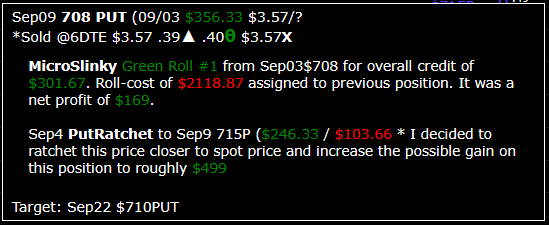
This is a Sep09 715P contract, but it didn’t start that way. Originally, when the previous contract was closed, and this one was opened, QQQ was lower in price, so I opened this for a target of $708 which you can see on the very first line of the notes. I sold the contract for $3.57, which brings in $356.33 after broker commissions of $0.65. The second line says @6DTE. What I mean by that is when I sold it, there were 6 days on the calendar until it expires. That’s why the dollar value is so low.
In my lexicon, it’s called a MicroSlinky Green Roll because anything inside 21 days is part of what I call the MicroSlinky. It’s green because we explained how the previous position, and all it’s history closed with a profit. Why does it say for overall credit of $301.67? This is because part of that new credit I received to sell the new contract I had to post on the old contract to extinguish it. This is part of my “ShadowLedger” mechanics so that I know in my mind that this contract really only advanced my cash by $301.67.
Now, on Sep4th I was analyzing positions, and realized I could improve this position a little, and bring it closer to a separate position you could have seen on the original image of a $720C. That’s a short call, and since I am a little nervous that short call might be breached, I pulled in this short put to battle against it next Wednesday.
So when I performed this adjustment, I paid $103.66 to close the contract, and open a new one immediately for $246.33 in credit. This raised the contract price to $715P from what was previously probably a tap-in gimme. Professionals would be all over this, and point out how it’s completely unnecessary to do this for such a tiny credit. I used to engage on Reddit with people about this type of action, but the hive mind is so lost they can’t see it and they criticize me.
I DON’T CARE !!!
This is all a game to me. Since 2011, and “The Well” I don’t give a shit about many things, and money was one of them. For those of you who have read the story of “The Well” you might know what I am talking about. I do give a shit about money now, but I don’t have any fear of losing.
Anyway, this raised the potential win on this contract from $356 to $499. Not a lot, but when you’re playing a game, points are points. I call that little move the “PutRatchet” because it ratchets up the heat just a little. A PutRatchet can also be used to lower risk, and I do it all the time to push a position to a win when it’s in a little bit of trouble. It’s like using the brakes and shifter in your car to adjust to the oncoming obstacles or roadway.
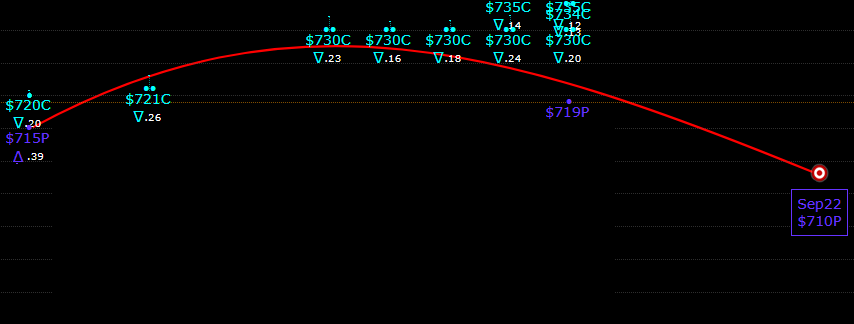
Now, at the end of the HoverNote, there’s a snippet that says “Target: Sep22 $710PUT”. This is theoretically where I might be sending this contract later. On the screen, this piece of data is visualized by the red arc leading to the target in the future where the canvas is still blank at $710P.
Why that date and strike? The thing that makes the MircoSlinky work so well is always having content on every date of the week to expire and roll, even if it’s only a couple hundred bucks. The key is setting up goalposts all the time that the market might go through, or maybe it pressures one side or the other.
It could happen that I adjust that strike when we get to Wednesday Sep9th next week. Sep22 will be a 14DTE roll, and as such, it probably will fetch a half decent price. I do want comfort in the distance from spot price to my contractual obligation though, so if I don’t have any short squeezes going on, this contract can be sold down at that level, and probably bring in another $400 or so.
What about all those Cyan colored numbers? Those are all my short positions against the QQQ. They’re Cyan, because they’re Call contracts, and since Cyan, and Call start with a C, it’s Cyan, that’s why.
Since I want to make sure I can make money whether the market goes up, or down, I sell short calls (bearish) and short puts (bullish) and just let them fight it out on the gameboard week after week. On a good number of those short call positions you can see two dots as opposed to one. This is because my conviction is stronger that QQQ will not rise above those positions. I call those AntMan positions because even though it’s only two contracts, they are quite powerful.
What if the price does surge? Then, I would ratchet my short Put (purple) positions up, and maybe even ratchet the Call (cyan) positions up as well. In the long run, the Market is going to do whatever it’s going to do. I may be wrong about direction, but I will never be wrong about time. Time keeps going, and going, and the value that can be harvested from Theta Θ is something that happens no matter what the direction of the stock.
The conclusion of the matter is, there’s value in Rolling if you focus on the details, and are mindful of where you’ve been, and where you think you’re going.
The full MicroSlinky map up until Sep18 is shown below. I’d love for the price to thread the needle the whole time, but it never does. So I will keep adjusting, and keep rolling while the market funds the entire game.
That’s how I ROLL.
Related Posts
MU – Micron
My Micron history is not that long. It’s obviously been part of my trading for a long time indirectly when you consider that it’s an
Definitions
Definitions I’ve grouped some of my basic interpretations and definitions of words I use in my lexicon. Some of these are real in the professional

MU Strangle Aug31
Micron Aug31 Strangle Micron has been very volatile for months now since earnings when they topped over $1200. The intensity has backed off from over