Micron Aug31 Strangle
Micron has been very volatile for months now since earnings when they topped over $1200. The intensity has backed off from over a 100%+ volatility rating on options down to ranges where it’s between 50% and 65%. I loved it when it was over 100%, but I have to be honest, it’s getting a bit easier to manage now that the volatility has died down a little.
Still MU stock price has been all over the place, so the option plays are equally as erratic. Friday Aug28th, MU closed the day at $932.86 -$2.53 -.27%
That’s actually a pretty minor daily change for Micron. All last week I have been setting up a strangle attempting what I call a “FieldGoal” that have been going wide right (through the PUT side) each time. That’s ok though, because each time a FieldGoal misses, it still catches some profit on the other side, just not 100%. When that happens, we are rolling all options anyway, but one of them has to carry it’s money into the next setup.
* See the FieldGoal analogy at the bottom of this post. I’ve put some definitions of terms at the bottom of this article in case you’re wondering what some of the lingo means.
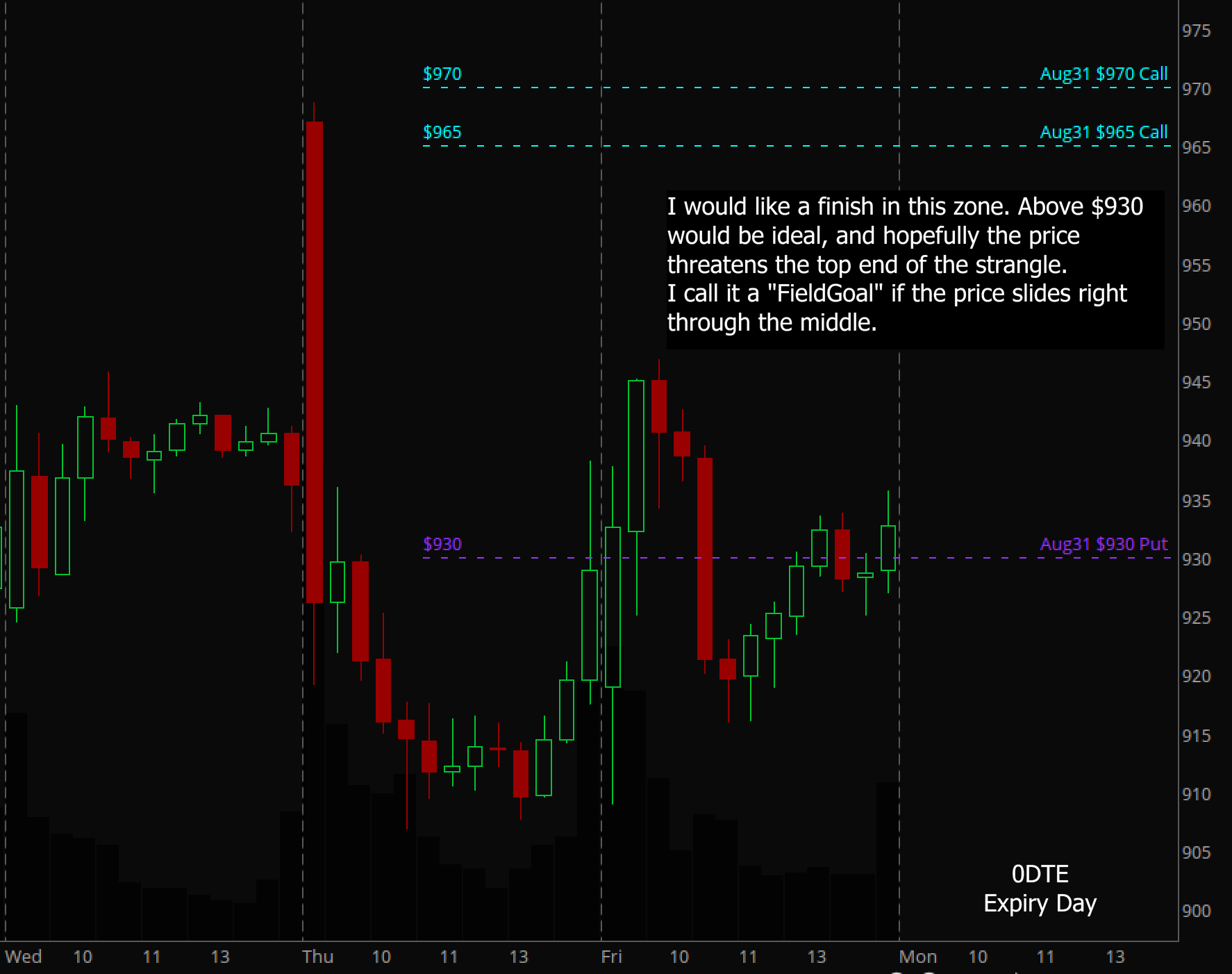
Here’s the setup going into Mondays expiry, we will see if the ball can sail through the uprights on this one. First the basics. In the chart below we see the price action since Wednesday up until Friday afternoon. The current positions in focus are setup like goalposts. Think of the lower short PUT line (purple) as the right upright for a field goal kicker. This is a long or bullish position because we want the price to stay above this level. The cyan colored lines at the top are my short calls which are short biased. I want the price to stay below this level at expiry. These short calls are fairly higher than the current price, and at this point in time appear to be the easy goal post to work with. See the comments after the image for the stats so far on these positions.
Ongoing Numbers
These short options will exist until Monday August 31st when I will either pay to close them and reopen at a future date, or just leave it closed for the time being. My usual pattern with stocks I enjoy working on though is to keep things going, and “roll” to future dates. This keeps the position generating cash credits out of short option positions.
First lets take a look at the left upright. The short calls are shown by the cyan colored lines. These two short calls are above the price, so there’s not much heat on them at the moment.
The $965 short call has rolled a couple times now, this is the 3rd time. Up until now, this position has banked gains totaling +$1,779. There is $520 more riding on this position, and if the price stays below $965, then that $520 becomes realized gains, and we look for a new date and strike for the next position, and some new cash obtained by selling premium.
The $970 short call has had some more success, and has a trailing bag of gains totaling +$2,946 on three previous rolls. With the potential full gain on this iteration of $337 I can add to that total on Monday afternoon if the price stays below the strike.
On the other goal post, we have the single short put option at $930. This one only has a trailing history of gains of +$901 because the price keeps coming too close upon expiry, and doesn’t realize it’s full potential. This week that could all change if it can hold above $930 near the end of the day. In fact, if it can stay inside the right upright, the potential gain is to bank +$4,068 and if not, it might bank some of those gains, or if the price tanks, it might shrink.
The short put side has been the more expensive option on the market because of the price constantly testing the low end, that’s why the premium on it is so high. For me that’s not a bad thing since I am selling the option, and not buying it.
What’s Next?
We have to see what happens Monday August 31 of course, but there’s two ways I see this going. If the price holds, and goes up a little, then the short put is something I am ready to take off the board, and focus on another one I have in the queue for Sep4$1000P. (See the next graphic). In that event, one of the short calls will roll toward that short put, and form a bit of an ambush because I already have a pair of short calls on Sep4 to hedge the short put. The other short call I might roll farther for more cash credit.
Price Dip? If the price dips below $930, I have to decide where I am willing to decide if I take a smaller win, and eliminate it, or if I roll it out once again, and look for a chance on Weds Sep2 for another perfect FieldGoal opportunity.
No matter what happens, I have to keep my eye on the timeline coming at me like a conveyor belt. Here’s a look at the board for the next week .
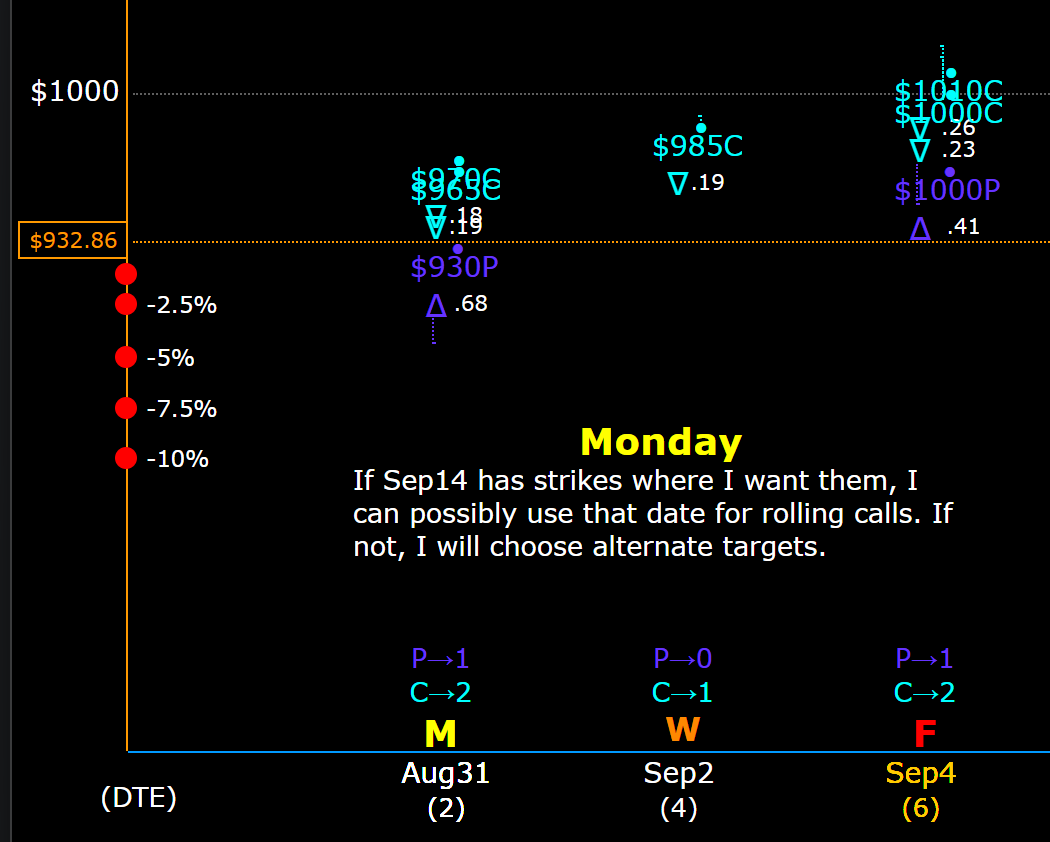
My “Slinky” Map
This image above is my custom made mapping tool I made to plan my moves for days and weeks ahead. This is just a snapshot of the days for the week of Aug31 to Sep4 and where things are situated right now. I have a $1000P (short put) sitting out there on Sep4th. With the price close on Friday down at $932.86, this has a little ways to run before it can overcome that hurdle. Believe it or not though, for MU this is totally possible, and I can’t be careless about setting my short calls too low.
The good news is that both the short call and short put at $1000 were both sold with very high premium because they were sold back on Aug11th, and Aug14th. At that time, there was still great uncertainty where MU’s price could go, so the market was willing to pay very high premiums on both those options.
When they’re stuck at the same price like that, it’s called a “Straddle” because we’ve got both options straddling a single price line. The $1010C a few bucks higher can be thought of as a strangle with the short put, but really what I am going for there right now is just to leave the cluster as is until the price action comes clearer, then I may step in and do some adjusting.
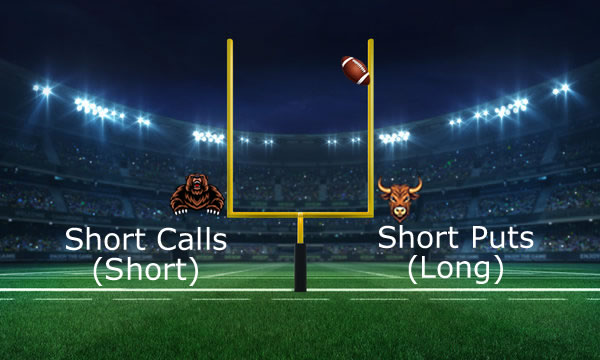
FieldGoal – Thinking of the distance between short options can be visualized as if it were the uprights of a goalpost in football. On one side, you have the “Short” positions, you want the price to stay below that level, and on the other side you have the “Long” positions where you want the price to stay above it. This is why I think of it as a “FieldGoal”. All options are short, but short puts actually have a “long bias” because by their nature, when you sell them, you don’t want the price to go below that strike.
Strike – This is the target price of a contract. If I have sold a call contract for August 31st at $970, the strike means the $970.
Premium – When an option contract is transacted, the premium is the price that is paid by the buyer or collected by the seller. The makeup of this price comes from several factors including volatility in the market, time remaining before expiry, and the distance the Strike has from the actual stock price.
Straddle – I think of this has having a mid point, and my positions straddle that like my legs would if I was sitting on a horse. As long as I am pretty close to the middle, things stay balanced, but if I end up too much to one side or the other, I might fall off the horse.
Strangle – This is mostly covered by the FieldGoal analogy. In clean terms, it means having options on both puts and calls but with some distance between them. As if you’re trying to “strangle” the price into the middle.
Realized Gain – This is used to describe the gains after contracts have been settled. Even though you get the cash up front, it can be days, or weeks until a contract expires, or is bought to close before it can be counted as “realized” gains. Until then, they are only potential gains. Once banked though, the only way to screw it up is to go about losing money on new contracts.
DTE – Days to Expiry. This is the relentless countdown to zero on the contract. As an option seller, we love for that countdown to come, and the option contract to be almost worthless. 0DTE is the day of expiry, and is always shown with a 0 (zero).
Roll – Rolling an option is when it’s being closed by paying a price, and then opened again on another date for a new price, and sometimes different strike. 99% of the time, we want to roll for credit. I will explain one day why I sometimes roll for a debit (or loss) for strategic purposes.
My Micron history is not that long. It’s obviously been part of my trading for a long time indirectly when you consider that it’s an important stock in the QQQ index. I also have pieces of MU in other ETFs that I own like QQQi and FEPi which are funds that own stocks, and attempt …
<a href="https://www.optionslinky.com/mu-micron/"