If you were to lend money to you, what rate would you charge? 0%? Probably. Let’s be realistic though. If you’re lending money to anyone these days how much can you get? A term deposit is likely a maximum of 3.5% or 4% if you’re super lucky. How low of an interest rate can you get with your bank, or broker when they lend money to you?
Can you get rates below 5% for the purposes of borrowing without any extra fees added like life insurance, loan insurance, taxes or other fees?
Here in Mexico, the best I could get on a personal short term loan was 9.1% and it was secured by putting up savings as collateral. Once they charge their 16% tax on the interest, the total net cost of borrowing ends up being about 10.9%. That’s not very good at all. I did a little checking, and I see that even in Canada and the USA the interest rates that one would normally pay as a retail client are anywhere from 8% up to 13.5% on loans such as this. The lowest I could find advertised were from 6.5% and up. I don’t know about the hidden fees, which there usually are when borrowing, so I’d venture to say it’s likely a little higher than that.

What? How can borrow money at 4%?
How could that be possible? It’s not very complex, and you just have to use tools that you might already have in your brokerage account. If not, you’d need to have the broker enable them for you.
There are some requirements to this, but it’s not that complex in how it functions. You need an investment brokerage account, options trading enabled, and margin which is like overdraft.
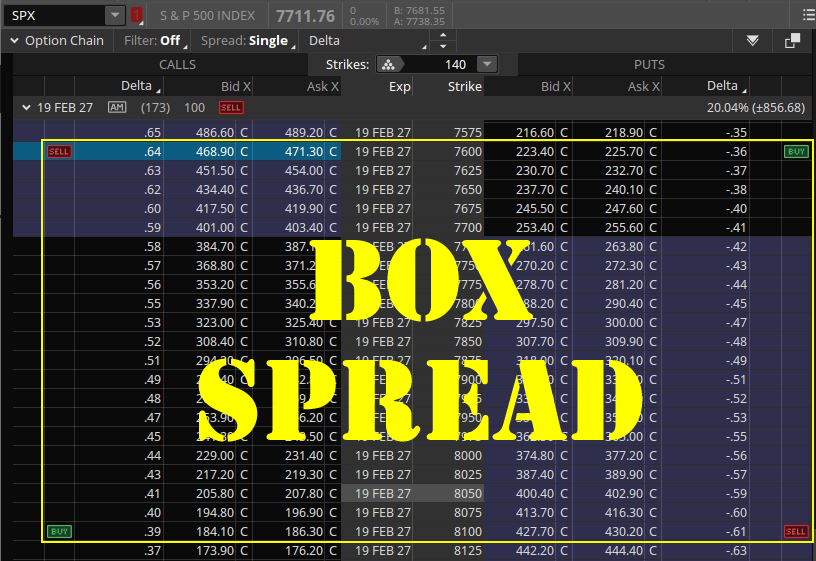
This is the “tool” we’re going to use that provides a deposit of cash to the account, and sets up the obligation to pay it back in a set period of time.
We use the symbol SPX which is the symbol representing the entire S&P500 index. We are not “trading” the SPX in this example, so ignore the high values of the index. They’re reference points in this exercise.
We don’t care where the price of the index goes for the purposes of the loan. We don’t care if it goes up, or down, or straight across. All we care about is creating a fixed BOX where our top end and bottom end are fixed and create no possible deviation from the purpose.
We’re going to setup what is called a Box Spread. It gets that name because you’re boxing in the prices on the outer limits of your option package. First we will look at the shape of it on an options screen, and that pretty much explains why it’s called a “Box Spread”.
There’s a combination of buying of a higher priced call and a lower priced put combined with a sell of a lower priced call, and higher priced put. We place the orders so that the buys and sells are in the opposite corners forming a “box” where the prices are matching on each side.
Now, no matter what happens with the price of SPX, even if it escapes out the sides of the box by a large degree, you will not be punished in any way at all. You are guaranteed the same result at the expiration of the contract no matter if SPX is high, or low.
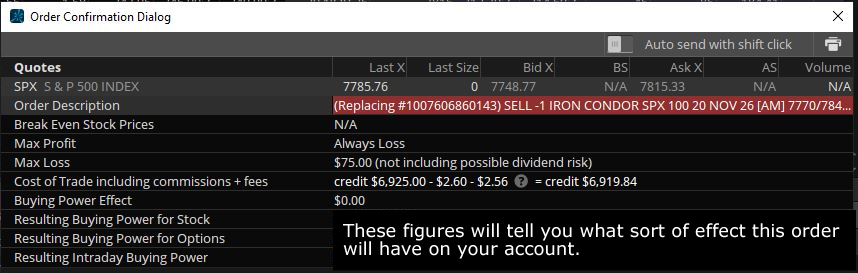
Let’s look at the trade ticket for the the monetary details. The next image shows actual cost of the operation (consider that your loan interest) and the credit (the amount you receive) when you execute the order.
Order Breakdown
I used the option closest to 6 months out as I could. Any longer, and the rates deviate from your favor a little, any shorter, and the rates don’t improve enough to make it worth the while.
Think of Feb19th as the date the loan is “due” except that you don’t make payments along the way, you simply pay the loan when it’s due. We will talk about payment schedule later on.
The amount you receive up front is $48,924.84. The amount of the loan when it’s due is $50,000. The difference is what will consider our cost of doing borrowing. The ticket says Max Loss is $1070, but we’re also paying some fees, so I count the cost of borrowing at $1,075.16.
The Buying Power Effect is an indicator that you will be using a virtual amount of your overdraft on your account by this amount. This will vary depending on your account size, and can also increase when you withdraw the money. It’s important to make sure you have enough headroom to pull off a loan like this. It’s basically like checking your credit score before doing the actual contract.
The net cost on this loan of $1075.16 divided by $48,924.84 is 2.19%. If you annualize that though, consider the annual interest rate as 4.38%.
Not bad right? Wait, it gets better.
Let’s talk about how you’re going to make payments on your loan. You didn’t think I was just going to leave it 6 months without paying anything right? WRONG! That’s not financially responsible. We make payments, but instead of that money leaving our account and going somewhere else, we’re going to create a little “holding tank” where we deposit our weekly payments leading up to the due date.
I do weekly because that’s the nature of my cash flow, if you do monthly it will work as well, but not as efficient.
We will be putting that money into a “BOXX” but it’s not just any box, like a shoe-box, this box will earn interest as we’re making the payments so that in February we have it all ready to make the lump sum payment.
If I make payments to my BOXX of $2,061.88 every week, on February 8th I make my final contribution and the loan amount will be satisfied. I will have made a total of $49,485.12 in contributions, but the balance inside my BOXX will be $50,000 on February 19th when the automatic debit happens, and the loan is paid.
What is the TRUE COST OF BORROWING?
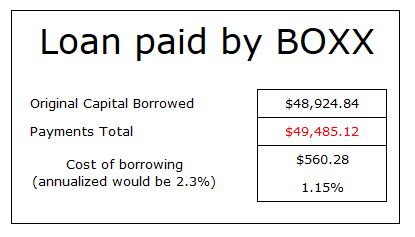
Take a moment now just to analyze what has happened over the life of this loan. You’ve only made payments of $49,485.12, on a loan that originally gave you $48,924.84 This means that you’re true cost of the loan was only $560.28
That’s only 1.15% interest over 6 months! Annualized to 365 days, that is still only 2.3% annualized interest.
That’s not even the best part of this. I did this exercise assuming that it’s a loan you’re using to buy a vehicle, or make a home improvement project or something.
What if you’re not taking the money out of your account though? What if you’re putting it to work from day one on something conservative yet productive?
There’s a whole world of choices you could have put this in and earn easily more than 5%. Whether you’re using this tool as a way to get a low interest loan, or provide a small amount of boost to your portfolio it’s a lower cost option of borrowing than what banks and typical lenders will provide.
Depending where you are taxed, it can also be a huge tax savings as you don’t have to sell your investments, potentially paying capital gains tax to get at your money.
Micron Aug31 Strangle Micron has been very volatile for months now since earnings when they topped over $1200. The intensity has backed off from over a 100%+ volatility rating on options down to ranges where it’s between 50% and 65%. I loved it when it was over 100%, but I have to be honest, it’s …
<a href="https://www.optionslinky.com/mu-aug-31/"
Burn and Learn The title of this article is Burn and Learn for a reason. The Dragon’s Eye definitely endured some heat this quarter. The wings got burned a little, as did the tail. The Eyes are still intact though, and the Dragon’s Eye is ready for what come next. This experiment is now 221 …
<a href="https://www.optionslinky.com/burn-and-learn/"
Milestone Dec31 101 days into this strategy, and now it’s the end of the year. The strategy has ultimately performed a little better than I had anticipated, and has offered me some learning opportunities that I enjoyed. First let’s get right to the performance measure. The time period was just a little more than a …
<a href="https://www.optionslinky.com/milestone-dec31/"